



|
Rev. Fr.
Leonard Goffine's REMARK The Mass of this Sunday is always the last, even if there are more than twenty-four Sundays after Pentecost; in that case the Sundays remaining after Epiphany, which are noticed in the calendar, are inserted between the twenty-third and the Mass of the twenty-fourth Sunday. The Introit of the Mass is the same as that said on the twenty-third Sunday after Pentecost. COLLECT Quicken, we beseech Thee, 0 Lord, the wills of Thy faithful: that they, more earnestly seeking after the fruit of divine grace, may more abundantly receive the healing gifts of Thy mercy. Thro'. EPISTLE (Col. I. 9—14.) Brethren, We cease not to pray for you, and to beg that you may be filled with the knowledge of the will of God, in all wisdom and spiritual understanding: that you may walk worthy of God, in all things pleasing, being fruitful in every good work, and increasing in the knowledge of God: strengthened with all might according to the power of his glory, in all patience and long-suffering with joy, giving thanks to God the Father, who hath made us worthy to be partakers of the lot of the saints in light; who hath delivered us from the power of darkness, and hath translated us into the kingdom of the Son of his love, in whom we have redemption through his blood, the remission of sins. EXPLANATION In this epistle St. Paul teaches us to pray for our neighbor, and to thank God especially for the light of the true, only saving faith. Let us endeavor to imitate St. Paul in his love and zeal for the salvation of souls, then we shall also one day partake of his glorious reward in heaven.
EXPLANATION When you shall see the abomination of desolation. The abomination of desolation of which Daniel (IX. 27.) and Christ here speak, is the desecration of the temple and the city of Jerusalem by the rebellious Jews by perpetrating the most abominable vices, injustices and robberies, &c., but principally by the pagan Romans by putting up their idols. This destruction which was accomplished in the most fearful manner about forty years after the death of Christ, was foretold by Him according to the testimony of St. Luke. (XXI. 20.) At the same time He speaks of the end of the world and of His coming to judgment, of which the desolation of Jerusalem was a figure. Pray that your flight be not in the winter or on the Sabbath. Because, as St. Jerome says, the severe cold which reigns in the deserts and mountains would prevent the people from going thither to seek security, and because it was forbidden by the law for the Jews to travel on the Sabbath. There shall rise false Christs and false prophets. According to the testimony of the Jewish historian Josephus, who was an eyewitness of the destruction of Jerusalem, Eleazar, John, Simon, &c., were such false prophets who under the pretence of helping the Jews, brought them into still greater misfortunes; before the end of the world it will be Antichrist with his followers, whom St. Paul calls the man of sin and the son of perdition, (II Thess. II. 3.) on account of his diabolical malice and cruelty. He will rise up, sit in the temple, proclaim himself God, and kill all who will not recognize him as such. His splendor, his promises and his false miracles will be such that even the holy and just will be in danger of being seduced, but for their sake God will shorten these days of persecution. Wheresoever the body shall be, there shall the eagles also be gathered together. That is, where the wicked are, who have aimed at spiritual corruption, there punishment will overtake and destroy them. This generation shall not pass till all these things be done. By these words Christ defines the time of the destruction of Jerusalem, and says that many of His hearers would live to see it, which also happened. But when the end of the world will come, He says, not even the angels in heaven know. (Matt. XXIV. 36.) Let us endeavor to be always ready by leading a holy life, for the coming of the divine Judge, and meditate often on the words of our divine Lord: Heaven and earth shall pass, but my words shall not pass. (See the account of the Destruction of Jerusalem on the Ninth Sunday after Pentecost.) PRAYER
Remove from us, O Lord, all that is calculated to rob us of Thy
love. Break the bonds with which we are tied to the world, that
we may not be lost with it. Give us the wings of eagles that we
may soar above all worldly things by the contemplation of Thy sufferings,
life and death, that we may hasten towards Thee now, and gather
about Thee, that we may not become a prey to the rapacious enemy
on the day of judgment. Amen. INSTRUCTION
CONCERNING PERJURY The Son of God here, and elsewhere in the gospel, confirms His word by an oath, as it were, for swearing is nothing else than to call upon God, His divine veracity, His justice, or upon His creatures in the name of God, as witness of the truth of our words. — Is swearing, then, lawful, and when? — It is lawful when justice or necessity or an important advantage requires it, and the cause is true and equitable. (Jer. IV. 2.) Those sin grievously, therefore, who swear to that which is false and unjust, because they call upon God as witness of falsehood and injustice, by which His eternal truthfulness and justice is desecrated; those sin who swear in a truthful cause without necessity and sufficient reason, because it is disrespectful to call upon God as witness for every trivial thing. In like manner, those sin grievously and constantly who are so accustomed to swearing as to break out into oaths, without knowing or considering whether the thing is true or false, whether they will keep their promise or not, or even if they will be able to keep it; such expose themselves to the danger of swearing falsely. "There is no one," says St. Chrysostom, "who swears often, who does not sometimes swear falsely, just as he who speaks much, sometimes says unbecoming and false things." Therefore Christ tells those who seek perfection, not to swear at all, (Matt. V. 34.) that they might not fall into the habit of swearing and from that into perjury. He who has the habit of swearing should, therefore, take the greatest pains to eradicate it; to accomplish which it will be very useful to reflect that if we have to render an account for every idle word we speak, (Matt. XII. 36.) how much more strictly will we be judged for unnecessary false oaths! God's curse accompanies him who commits perjury, in all his ways, as proved by daily experience. He who commits perjury in court, robs himself of the merits of Christ's death and will be consumed in the fire of hell, which is represented by the crucifix and burning tapers, in presence of which the oath (in some places) is taken. If you have had the misfortune to be guilty of perjury, at once be truly sorry, weep for this terrible sin which you have committed, frankly confess it, repair the injury you may have caused by it, and chastise yourself for it by rigorous penance. |
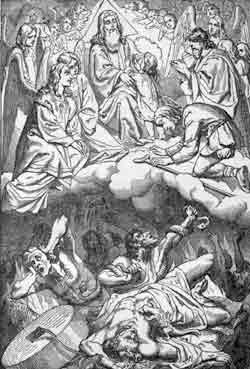 GOSPEL
(Matt. XXIV. 15—35.) At
that time, Jesus said to his disciples:
When you shall see the abomination of
desolation, which was spoken of by Daniel
the prophet, standing in the holy place:
he that readeth, let him understand: then
they that are in Judea, let them flee
to the mountains: and he that is on
the house-top, let him not come down to
take anything out of his house: and he
that is in the field, let him not go back
to take his coat. And woe to them that
are with child, and that give suck, in
those days. But pray that your flight
be not in the winter, or on the Sabbath.
For there shall be then great tribulation,
such as hath not been from the beginning
of the world until now, neither shall
be: and unless those days had been shortened,
no flesh should be saved: but for the
sake of the elect, those days shall be
shortened. Then, if any man shall say
to you: Lo, here is Christ, or there:
do not believe him: for there shall arise
false Christs and false prophets, and
shall show great signs and wonders, insomuch
as to deceive (if possible) even the elect.
Behold, I have told it to you before hand:
if therefore they shall say to you: Behold,
he is in the desert, go ye not out; Behold,
he is in the closets, believe it not.
For as lightning cometh out of the east,
and appeareth even into the west, so shall
also the coming of the Son of man be.
Wheresoever the body shall be, there shall
the eagles also be gathered together.
And immediately after the tribulation
of those days, the sun shall be darkened,
and the moon shall not give her light,
and the stars shall fall from heaven,
and the powers of the heavens shall be
moved: and then shall appear the sign
of the Son of man in heaven, and then
shall all the tribes of the earth mourn,
and they shall see the Son of man coming
in the clouds of heaven with much power
and majesty: and he shall send his
angels with a trumpet and a great voice,
and they shall gather together his
elect from the four winds, from the
farthest parts of the heavens
to the utmost bounds of them. And
from the fig-tree learn a parable: when
the branch thereof is now tender, and
the leaves come forth, you know that summer
is nigh. So you also, when you
shall see all these things, know ye that
it is nigh, even at the doors. Amen I
say to you, that this generation shall
not pass till all these things be done.
Heaven and earth shall pass, but my
words shall not pass.
GOSPEL
(Matt. XXIV. 15—35.) At
that time, Jesus said to his disciples:
When you shall see the abomination of
desolation, which was spoken of by Daniel
the prophet, standing in the holy place:
he that readeth, let him understand: then
they that are in Judea, let them flee
to the mountains: and he that is on
the house-top, let him not come down to
take anything out of his house: and he
that is in the field, let him not go back
to take his coat. And woe to them that
are with child, and that give suck, in
those days. But pray that your flight
be not in the winter, or on the Sabbath.
For there shall be then great tribulation,
such as hath not been from the beginning
of the world until now, neither shall
be: and unless those days had been shortened,
no flesh should be saved: but for the
sake of the elect, those days shall be
shortened. Then, if any man shall say
to you: Lo, here is Christ, or there:
do not believe him: for there shall arise
false Christs and false prophets, and
shall show great signs and wonders, insomuch
as to deceive (if possible) even the elect.
Behold, I have told it to you before hand:
if therefore they shall say to you: Behold,
he is in the desert, go ye not out; Behold,
he is in the closets, believe it not.
For as lightning cometh out of the east,
and appeareth even into the west, so shall
also the coming of the Son of man be.
Wheresoever the body shall be, there shall
the eagles also be gathered together.
And immediately after the tribulation
of those days, the sun shall be darkened,
and the moon shall not give her light,
and the stars shall fall from heaven,
and the powers of the heavens shall be
moved: and then shall appear the sign
of the Son of man in heaven, and then
shall all the tribes of the earth mourn,
and they shall see the Son of man coming
in the clouds of heaven with much power
and majesty: and he shall send his
angels with a trumpet and a great voice,
and they shall gather together his
elect from the four winds, from the
farthest parts of the heavens
to the utmost bounds of them. And
from the fig-tree learn a parable: when
the branch thereof is now tender, and
the leaves come forth, you know that summer
is nigh. So you also, when you
shall see all these things, know ye that
it is nigh, even at the doors. Amen I
say to you, that this generation shall
not pass till all these things be done.
Heaven and earth shall pass, but my
words shall not pass.