|
Rev. Fr.
Leonard Goffine's
The Church's Year
Twenty-Third
Sunday After Pentecost
REMARK
If from Pentecost until Advent there be only twenty-three Sundays,
the following one is omitted, and the Mass of the twenty-fourth
is said.
The Introit of the Mass consoles
and incites us to confidence in God who is so benevolent towards
us, and will not let us pine away in tribulation. The Lord saith:
I think thoughts of peace, and not of affliction: you shall call
upon me, and I will hear you: and I will bring back your captivity
from all places. (Fer. XXIX. 11. 12. 14.) Lord, thou hast blessed
thy land: thou hast turned away the captivity of Jacob. (Ps. LXXXIV.)
Glory etc.
COLLECT Absolve, we beseech Thee, 0 Lord,
Thy people from their offences: that through Thy bountiful goodness
we may be freed from the bonds of those sins which through our frailty
we have contracted. Thro',
EPISTLE (Philipp. III 17-21.: IV, 1-3.)
Brethren, Be followers of me, and observe them who walk so as you
have our model. For many walk, of whom I have told you often (and
now tell you weeping), that they are enemies of the cross of Christ:
whose end is destruction, whose God is their belly, and whose glory
is in their shame, who mind earthly things. But our conversation
is in heaven: from whence also we look for the Saviour, our Lord
Jesus Christ, who will reform the body of our lowness, made like
to the body of his glory, according to the operation whereby also
he is able to subdue all things unto himself. Therefore, my dearly
beloved brethren, and most desired, my joy and my crown: so stand
fast in the Lord, my dearly beloved. I beg of Evodia, and I beseech
Syntyche, to be of one mind in the Lord. And I entreat thee also,
my sincere companion, help those women who have labored with me
in the gospel with Clement and the rest of my fellow-laborers, whose
names are in the book of life.
EXPLANATION
There are unhappily many Christians, who,
as St. Paul complains, are, declared enemies
of Christ's cross, who do not wish to
mortify their senses, who only think of
gratifying their lusts, and, as it were,
find their only pleasure, even seek their
honor, in despising the followers of Jesus
and His saints on the narrow path of the
cross, of mortification and humiliation.
What will be the end of these people?
Eternal perdition! For he who does not
crucify the flesh, does not belong to
Christ. (Gal. V. 24.) He who does not
bear the marks of the mortification of
Jesus in his body, in him the life of
Christ shall not be manifested. (II Cor.
IV. 10.) He who does not walk in heaven
during his life-time, that is, who does
not direct his thoughts and desires heavenward,
and despise the world and its vanities,
will not find admission there after his
death.
ASPIRATION
Would to God , I could say with St. Paul: The world is crucified
to me, and I to the world. (Gal. VI. 14.)
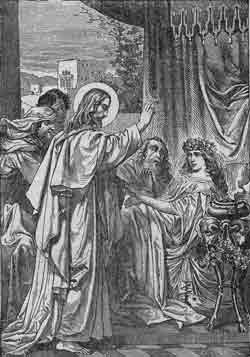 GOSPEL
(Matt. IX. 18-26.) At that time,
As Jesus was speaking to the multitudes,
behold, a certain ruler came up, and adored
him, saying: Lord , my daughter is even
now dead: but come, lay thy hand upon
her, and she shall live. And Jesus, rising
up, followed him, with his disciples.
And behold, a woman, who was troubled
with an issue of blood twelve years, came
behind him, and touched the hem of his
garment. For she said within herself:
If I shall touch only his garment, I shall
be healed. But Jesus turning and seeing
her, said: Be of good heart, daughter:
thy faith hath made thee whole. And the
woman was made whole from that hour. And
when Jesus was come into the house of
the ruler, and saw the minstrels and the
multitude making a tumult, he said: Give
place: for the girl is not dead, but sleepeth.
And they laughed him to scorn. And when
the multitude was put forth, he went in,
and took her by the hand. And the maid
arose. And the fame hereof went abroad
into all that country. GOSPEL
(Matt. IX. 18-26.) At that time,
As Jesus was speaking to the multitudes,
behold, a certain ruler came up, and adored
him, saying: Lord , my daughter is even
now dead: but come, lay thy hand upon
her, and she shall live. And Jesus, rising
up, followed him, with his disciples.
And behold, a woman, who was troubled
with an issue of blood twelve years, came
behind him, and touched the hem of his
garment. For she said within herself:
If I shall touch only his garment, I shall
be healed. But Jesus turning and seeing
her, said: Be of good heart, daughter:
thy faith hath made thee whole. And the
woman was made whole from that hour. And
when Jesus was come into the house of
the ruler, and saw the minstrels and the
multitude making a tumult, he said: Give
place: for the girl is not dead, but sleepeth.
And they laughed him to scorn. And when
the multitude was put forth, he went in,
and took her by the hand. And the maid
arose. And the fame hereof went abroad
into all that country.
INSTRUCTIONS
I. Filial was the faith, unbounded the
confidence, profound the humility of this
woman and therefore she received health
also. Learn from this, how pleasing to
the Lord is faith, confidence and humility;
let your prayer always be penetrated by
these three virtues, and you will receive
whatever you ask.
II. The devout Louis de Ponte
compares the conduct of this woman to our conduct at holy Communion,
and says: Christ wished to remain with us in the most holy Eucharist,
clothed with the garment of the sacramental species of bread, that
he who receives His sacred flesh and blood, may be freed from evil
concupiscence. If you wish to obtain the health of your soul, as
did this woman the health of the body, imitate her. Receive the
flesh and blood of Jesus with the most profound humility, with the
firmest confidence in His power and goodness, and like this woman
you too will be made whole.
III.
Jesus called three dead persons to life,
the twelve-year-old daughter of Jairus,
ruler of the synagogue, of whom there
is mention made in this gospel, the young
man at Naim, (Luke VII. 14.) and Lazarus.
(John. XI- 43.) By these three dead persons
three classes of sinners may be understood:
the maiden signifies those who sin in
their youth through weakness and frailty,
but touched by the grace of God, perceive
their fall and easily rise again through
penance; by the young man at Naim those
are to be understood who sin repeatedly
and in public, these require greater grace,
more labor and severer penance; by Lazarus,
the public and obdurate habitual sinners
are to be understood who can be raised
to spiritual life only by extraordinary
graces and severe public penance.
IV.
Christ did not raise the maiden until
the minstrels and noisy multitude were
removed, by which He wished to teach us
that the conversion of a soul cannot be
accomplished in the midst of the noise
and turmoil of temporal cares, idle pleasures
and associations.
INSTRUCTION
CONCERNING RIDICULE AND DERISION
And they laughed him to
scorn. (Matt IX. 24.)
When
Jesus told the minstrels and the crowd
that the girl was not dead, but sleeping,
they laughed at Him, because they understood
not the meaning of His words. Sensually-minded
men generally act in the same manner towards
the priests and ministers of God, who
by their word and example admonish them
to despise honors, riches and pleasures,
and to embrace the love of poverty, humility
and mortification. This is an unintelligible
and hateful language to them which they
ridicule and mock just as they do when
they hear that death is a sleep, from
which we shall one day awake and be obliged
to appear before the judgment-seat of
God. Woe to such scoffers by whose ridicule
so many souls are led from the path of
virtue! What the devil formerly accomplished
by tyrants in estranging men from God
and a lively faith in Him and His Church,
he seems to wish to accomplish in our
days by the mockery, scoffs, and blasphemies
of wicked men; for at no period have piety
and virtue, holy simplicity and childlike
faith, adherence to the holy Roman Church
and her laws, reverence for her head,
her ministers and priests, been more mocked,
derided and blasphemed. Unhappily many
permit themselves to be induced by mockery
to abandon piety, to omit the public practice
of their faith, to conceal their Catholic
conviction, and to lead a lukewarm, careless,
indeed, sinful life. Woe to the scoffers!
they are an abomination to the Lord (Prov.
III. 32.) who will one day require from
their hands all the souls perverted by
them. Do not permit yourself to be led
astray by those who ridicule your faith
and zeal for virtue; remember the words
of Jesus: He that shall deny me before
men, I will also deny him before my Father
who is in heaven. (Matt. X. 33.) Let Jesus
be your consolation, He was scoffed and
blasphemed for your sake, and often say
within yourself:
I know, my most amiable Jesus,
that the servant cannot be more than his master. Since Thou wert
so often sneered at, mocked and blasphemed, why should I wonder
if I am derided for my faith in Thee and Thy Church, and for the
practice of virtue!
|




