|
Rev.
Fr. Leonard Goffine's
The Church's Year
SEXAGESIMA
SUNDAY
In the Introit of this day's
Mass, the Church brings before us one who seeks to be loosed from
his sins, and calls on God for help and assistance. Arise, why sleepest
thou , O Lord? arise, and cast us not off to the end: why turnest
thou thy face away, and forgettest our trouble? Our belly hath cleaved
to the earth: arise, O Lord, help us and deliver us. O God, we have
heard with our ears; our Fathers have declared to us. (Ps. XLIII.
23. 25.) Glory be to the Father, &c.
COLLECT
O God, who seest that we trust not in aught we do; mercifully grant
that by the protection of the Doctor of the Gentiles we may be defended
against all adversities. Through our Lord Jesus Christ, &c.
EPISTLE
(II. Cor. XI. 19-33; to XII. 1-9,) Brethren,
you gladly suffer the foolish; whereas
yourselves are wise. For you suffer if
a man bring you into bondage, if a man
devour you, if a man take from you, if
a man be lifted up, if a man strike you
on the face. I speak according to dishonor,
as if we had been weak in this part. Wherein
if any man dare (I speak foolishly), I
dare also. Are they Hebrews? so am I.
Are they Israelites? so am I. Are they
the seed of Abraham? so am I. Are they
the ministers of Christ (I speak as one
less wise,) I am more: in many more labors,
in prisons more frequently, in stripes
above measure, in deaths often. Of the
Jews five times did I receive forty stripes
save one. Thrice was I beaten with rods;
once was I stoned; thrice I suffered shipwreck;
a night and a day I was in the depth of
the sea. In journeying often, in perils
of waters, in perils of robbers, in perils
from my own nation, in perils from the
Gentiles, in perils in the city, in perils
in the wilderness, in perils in the sea,
in perils from false brethren. In labor
and painfulness, in much watchings, in
hunger and thirst, in fastings often,
in cold and nakedness; besides those things
which are without, my daily instance,
the solicitude for all the Churches. Who
is weak, and I am not weak? Who is scandalized,
and I am not on fire? If I must needs
glory, I will glory of the things that
concern my infirmity. The God and Father
of our Lord Jesus Christ, who is blessed
forever, knoweth that I lie not. At Damascus
the governor of the nation under Aretas
the king, guarded the city of the Damascenes
to apprehend me; and through a window
in a basket was I let down by the wall,
and so escaped his hands. If I must glory
(it is not expedient indeed); but I will
come to the visions and revelations of
the Lord. I know a man in Christ above
fourteen years ago, (whether in, the body
I know not, or out of the body, I know
not, God knoweth): such an one rapt even
to the third heaven. And I know such a
man (whether in the body or out of the
body, I cannot tell, God knoweth) : that
he was caught up into paradise; and heard
secret words, which it is not granted
to man to utter. For such an one I will
glory; but for myself I will glory nothing,
but in my infirmities. For though I should
have a mind to glory, I shall not be foolish;
for I will say the truth. But I forbear,
lest any man should think of me above
that which he seeth in me, or anything
he heareth from me. And lest the greatness
of the revelations should exalt me, there
was given me a sting of my flesh, an angel
of Satan, to buffet me. For, which thing
thrice I besought the Lord, that it might
depart from me. And he said to me: My
grace is sufficient for thee; for power
is made perfect in infirmity. Gladly therefore
will I glory in my infirmities, that the
power of Christ may dwell in me.
Why is
St. Paul mentioned in the Mass of this day, and why is this epistle
read?
Because in Rome the Station
or Church service is held on this day in the Church of St. Paul
and because the Church continues to encourage us to work according
to the example given by St. Paul who, with the grace of God, accomplished
and suffered so much; also because we should labor for the honor
of God and the salvation of our souls and faithfully cooperate with
the grace of God.
Why,
at the beginning of this epistle, does
St. Paul say so much to his own praise?
Not
out of ambition for honor and glory, but
to honor God, and for the love and advantage
of the Corinthians, who allowed themselves
to be deceived by mercenary impostors
and false prophets; that he might make
public the craftiness of those deceivers
who assumed the appearance of the true
apostles, as Satan took the form of a
good angel. To shame these, and to remove
the obstacles they had placed in the way
of the gospel, St. Paul was obliged to
reveal to the Corinthians the things he
had performed and endured in propagating
the holy gospel. By trials and sufferings
is the true apostle known; the false apostles,
the hirelings, as Christ calls them, only
care for their own bodies, for temporal
advantages, not for the salvation of souls.
We see this exemplified in our days by
the heretical missionaries who, when there
is suffering, when there is martyrdom,
take to flight, for their eyes are directed
only to the present life and a large income,
while the Catholic missionaries rejoice
if, for Christ's sake, and for the salvation
of souls, they are permitted to suffer,
and made worthy to endure the cruel death
of the martyr.
Of whom
does St. Paul relate such marvels?
Of himself, but from humility
and modesty he does not say so; fourteen years before, forty-four
years after the birth of Christ, St. Paul was rapt to the third
heaven, that is, to the abode of happy spirits; but to preserve
him in humility God permitted Satan to use the concupiscence of
the flesh, which is like a sting in the body of man, as a temptation
to the apostle, and by which he was continually tormented.
ASPIRATION
Grant me, O God, thy grace that in these
evil days of false doctrines I may remain
steadfast to Thy holy gospel which in
the holy Catholic Church remains pure
and unchanged; never let me be deterred
from obeying its precepts, neither by
the charms of the world nor by the mockery
and reproaches of the wicked.
GOSPEL
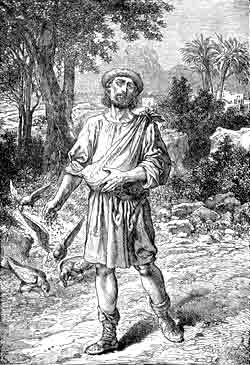
(Luke VIII. 4-15.) At that time, when very great multitude was gathered
together and hastened out of the cities unto him, he spoke by a
similitude: The sower went out to sow his seed. And as he sowed,
some fell by the wayside; and it was trodden down, and the fowls
of the air devoured it. And other some fell upon a rock; and as
soon as it was sprung up, it withered away, because it had no moisture.
And other some fell among thorns; and the thorns growing up with
it, choked it. And other some fell upon good ground; and being sprung
up, yielded fruit a hundredfold. Saying these things, he cried out:
He that hath ears to hear, let him hear. And his disciples asked
him what this parable might be. To whom he said: To you it is given
to know the mystery of the kingdom of God, but to the rest in parables;
that seeing, they may not see, and hearing, they may not understand.
Now the parable is this: The seed is the word of God. And they by
the way-side are they that hear: then the devil cometh, and taketh
the word out of their heart, lest believing they should be saved.
Now they upon the rock are they who, when they hear, receive the
word with joy; and these have no roots, for they believe for a while,
and in time of temptation they fall away. And that which fell among
thorns are they who have heard, and going their way, are choked
with the cares arid riche, and pleasures of this life, and yield
no fruit. But that on the good ground are they who, in a good and
perfect heart, hearing the word, keep it, and bring forth fruit
in patience.
Why is
the Word of God compared to a seed?
Because from the word of
God germinates the fruit of good works, as from good seed grows
good fruit; as it is impossible, therefore, for an unsowed field
to produce good fruit, so is it impossible for man without the seed
of God's word to produce good fruits of the spirit.
Why does
Christ cry out an the parable: He that hath ears to hear, let him
hear?
Because of the importance
and necessity of the doctrine which was contained in the parable.
For to hear the word of God is absolutely necessary for salvation,
as the Apostle indicates: How shall they believe him (Jesus) of
whom they have not heard? (Rom. X. 14.) Jesus calls those happy
who hear the word of God and keep it. (Luke XI. 28.) And on this
subject St. Augustine says: "Be assured, my brethren, that
as the body becomes weakened by want and hunger, and wastes to a
mere shadow, so the soul that is not nourished by the word of God,
becomes shrunken, worthless and unfit for any good work."
Whence
comes so much cockle of evil, when the seed of God's word is so
abundantly sowed?
Because, as Christ says,
the seed falls now by the wayside, now upon a rock, now among thorns,
seldom upon good soil, that is to say, those who hear the word of
God are as a highway, over which many distracting thoughts are traveling
which tread down the scattered seed, or, like fowls of the air devour
it; they are like rocks, hardened by their prejudices or repeated
crimes, so that the divine word cannot take root; again, they are
so overgrown by the thorns of worldly cares, the constant desire
for wealth and riches, and sensual delights, that even if they receive
the seed, it is unable to grow and bear fruit.
ON
THE POWER OF GOD’S WORD
The
word of God is compared, by the Prophet
Jeremias, to a hammer which crushes hearts
as hard as rocks, and to a fire that dries
up the swamps of vice, and consumes inveterate
evil habits. (Jer. XXIII. 29.) The Psalmist
compares it to thunder that makes all
tremble, a storm-wind that bends and breaks
the cedars of Lebanon, that is, proud
and obstinate spirits; a light that dispels
the darkness of ignorance; and a remedy
that cures sin. (Ps. XXVIII. 3. 5., CXVIII.
105.) St. Paul compares it to a sword
that divides the body from the soul, that
is, the carnal desires from the spirit;
(Hebr. IV. 12.) the Apostle James to a
mirror in which man sees his stains and
his wrongs. (Jam. I, 23.) the Prophet
Isaias to a precious rain that moistens
the soil of the soul and fertilizes it;
(Isai: LV. 10. 11.) and Jesus Himself
compares it to a seed that when it falls
on good ground, brings forth fruit a hundredfold.
(Luke VIII. 8.) One single grain of this
divine seed produced the most marvellous
fruits of sanctity in St. Augustine, St.
Anthony the Great, in St. Nicholas of
Tolentino, and others; for St. Augustine
was converted by the words: "Let
us walk
honestly as in the day: not in rioting
and drunkenness, not in chambering and
impurities, not in contention and envy."
(Rom. XIII. 13.) St. Anthony by the words:
If thou wilt be perfect, go, sell what
thou hast, and give to the poor, and thou
shaft have treasure in heaven; and come,
follow me." (Matt XIX. 21.) Nicholas
of Tolentino was brought to Christian
perfection by the words: "Love not
the world, nor the things which are in
the world. (I. John II. 15.)
How should
we prepare ourselves to be benefited by the word of God?
We must be good, well-tilled
soil, that is, we must have a heart that loves truth, desires to
learn, and humbly and sincerely seeks salvation; we must listen
to the word of God with due preparation and attention, keep the
divine truths we have heard, in our heart, frequently consider and
strive to fulfil them.
What should
be done before the sermon?
We should endeavor to purify
our conscience, for, as St. Chrysostom demands; "Who would
pour precious juice into a vessel that is not clean, without first
washing it?" We should, therefore, at least cleanse our hearts
by an ardent sorrow for our sins, because the spirit of truth enters
not into the sinful soul; (Wisd. I. 4.) we should ask the Holy Ghost
for the necessary enlightenment, for little or no fruit can be obtained
from a sermon if it is not united with prayer; we should listen
to the sermon with a good motive; that is, with a view of hearing
something edifying and instructive; if we attend only through curiosity,
the desire to hear something new, to criticize the preacher, or
to see and to be seen, we are like the Pharisees who for such and
similar motives went to hear Christ and derived no benefit therefrom.
“As a straight sword goes not into a crooked sheath, so the word
of God enters not into a heart that is filled with improper motives."
We should strive to direct, our minds rightly, that is, to dispel
all temporal thoughts, all needless distraction, otherwise the wholesome
words would fall but upon the ears, would not penetrate the heart,
and the words of Christ be fulfilled: They have ears, and hear not.
How should
we comfort ourselves during the sermon?
We
should listen to the sermon with earnest,
reverent attention, for God speaks to
us through His priests, and Christ says
to them: Who hears you, hears me. (Luke
X. 16.) We
must listen to the priests, therefore,
not as to men, but as to God's ambassadors,
for every priest can say with St. Paul:
We are ambassadors for Christ, God, as
it were, exhorting by us. (II. Cor. V.
20.) "If," says St. Chrysostom,
"when the letter of a king is read,
the greatest quiet and attention prevails,
that nothing may be lost, how much more
should we listen with reverence and perfect
silence to the. word of God?"
The word of God is, and ever will be,
a divine seed, which, when properly received,
produces precious fruit, by what priest
soever sowed; for in the sowing it matters
not what priest sows, but what soil is
sowed. Be careful, also, that you do not
apply that which is said to others, but
take it to yourself, or the sermon will
be of no benefit to you. Are you free
from those vices which the preacher decries
and against which he battles? then, thank
God, but do not despise others who are
perhaps laboring under them, rather pray
that they may be released and you preserved
from falling into them. Keep also from
sleeping, talking, and other distractions,
and remember, that whoever is of God,
also willingly hears his word. (John VIII.
47.)
What should
be done after the sermon?
We should then strive to
put into practice the good we have heard, for God justifies not
those who hear the law, but those who keep it, (Rom. II. 13.) and
those who hear the word of God and do not conform their lives to
it, are like the man who looks into the mirror, and having looked
into it goes away, and presently forgets what manner of man he is.
(Fam. I. 23. 24.) To practice that which has been heard, it is above
all necessary that it should be kept constantly in mind, and thoughtfully
considered. St. Bernard says: "Preserve the word of God as
you would meat for your body, for it is a life-giving bread, and
the food of your soul. Happy those, says Christ, who keep it. Receive
it, therefore, into your soul's interior, and let it reach your
morals and your actions."
That food which cannot be
digested, or is at once thrown out, is useless; the food should
be well masticated, retained, and by the digestive powers worked
up into good blood. So not only on the day, but often during the
week, that which was heard in the sermon should be thought of and
put into practice. Speak of it to others, thus will much idle talk
be saved, many souls with the grace of God roused to good, and enlightened
in regard to the evil they had not before seen in themselves and
in future will avoid. Let us listen to others when they repeat what
was said in the sermon. Heads of families should require their children
and domestics to relate what they have heard preached. Let us also
entreat God to give us grace that we may be enabled to practice
the precepts given us.
PRAYER
How much am I shamed, O my God, that the seed of Thy Divine word,
which Thou hast sowed so often and so abundantly in my heart, has
brought forth so little fruit! Ah! have mercy on me, and so change
my heart, that it may become good soil, in which Thy word may take
root, grow without hindrance, and finally bring forth fruits of
salvation. Amen.
|




