



|
Rev.
Fr. Leonard Goffine's SEPTUAGESIMA SUNDAY Why is this Sunday called "Septuagesima"? Because in accordance with the words of the First Council of Orleans, some pious Christian congregations in the earliest ages of the Church, especially the clergy, began to fast seventy days before Easter, on this Sunday, which was therefore called Septuagesima" - the seventieth day. The same is the case with the Sundays following, which are called Sexagesima, Quinquagesima , Quadragesima, because some Christians commenced to fast sixty days, others fifty, others forty days before Easter, until finally, to make it properly uniform, Popes Gregory and Gelasius arranged that all Christians should fast forty days before Easter, commencing with Ash Wednesday. Why, from this day until Easter, does the Church omit in her service all joyful canticles, alleluias, and the Gloria in excelsis etc? Gradually to prepare the minds of the faithful for the serious time of penance and sorrow; to remind the sinner of the grievousness of his errors, and to exhort him to penance. So the priest appears at the altar in violet, the color of penance, and the front of the altar is covered with a violet curtain. To arouse our sorrow for our sins, and show the need of repentance, the Church in the name of all mankind at the Introit cries with David: The groans of death surrounded me, the sorrows of hell encompassed me: and in my affliction I called upon the Lord, and he heard my voice from his holy temple. (Ps. XVII, 5-7.) I will love thee, O Lord, my strength; the Lord is my firmament, and my refuge, and my deliverer. (Fs. XVII. 2-3.) Glory be to the Father, etc. COLLECT O Lord, we beseech Thee graciously hear the prayers of Thy people; that we who are justly afflicted for our sins may, for the glory of Thy name, mercifully be delivered. Through our Lord, Jesus Christ etc. EPISTLE (I. Cor. IX. 24-27., to X. 1-5.) Brethren, know you not that they that run in the race, all run indeed, but one receiveth the prize? So run, that you may obtain. And every one that striveth for the mastery, refraineth himself from all things: and they indeed that they may receive a corruptible crown, but we an incorruptible one. I therefore so run, not as at an uncertainty; I so fight, not as one beating the air; but I chastise my body, and bring it into subjection; lest perhaps, when I have preached to others, I myself should become a castaway. For I would not have you ignorant, brethren, that our fathers were all under the cloud, and all passed through the sea: and all in Moses were baptized, in the cloud and in the sea; and did all eat the same spiritual food, and all drank the same spiritual drink (and they drank of the spiritual rock that followed them: and the rock was Christ); but with the most of them God was not well pleased. EXPLANATION Having exhorted us to penance in the Introit of the Mass, the Church desires to indicate to us, by reading this epistle, the effort we should make to reach the kingdom of heaven by the narrow path (Matt. VII. 13.) of penance and mortification. This St. Paul illustrates by three different examples. By the example of those who in a race run to one point, or in a prize-fight practice and prepare themselves for the victor's reward by the strongest exercise, and by the strictest abstinence from everything that might weaken the physical powers. If to win a laurel-crown that passes away, these will subject themselves to the severest trials and deprivations, how much more should we, for the sake of the heavenly crown of eternal happiness, abstain from those improper desires, by which the soul is weakened, and practice those holy virtues, such as prayer, love of God and our neighbor, patience, to which the crown is promised! Next, by his own example, bringing himself before them as one running a race, and fighting for an eternal crown, but not as one running blindly not knowing whither, or fighting as one who strikes not his antagonist, but the air; on the contrary, with his eyes firmly fixed on the eternal crown, certain to be his who lives by the precepts of the gospel, who chastises his spirit and his body as a valiant champion, with a strong hand, that is, by severest mortification, by fasting and prayer. If St. Paul, notwithstanding the extraordinary graces which he received, thought it necessary to chastise his body that he might not be cast away, how does the sinner expect to be saved, living an effeminate and luxurious life without penance and mortification? St. Paul's third example is that of the Jews who all perished on their journey to the Promised Land, even though God had granted them so many graces; He shielded them from their enemies by a cloud which served as a light to them at night, and a cooling shade by day; He divided the waters of the sea, thus preparing for them a dry passage; He caused manna to fall from heaven to be their food, and water to gush from the rock for their drink. These temporal benefits which God bestowed upon the Jews in the wilderness had a spiritual meaning; the cloud and the sea was a figure of baptism which enlightens the soul, tames the concupiscence of the flesh, and purifies from sin; the manna was a type of the most holy Sacrament of the Altar, the soul's true bread from heaven; the water from the rock, the blood flowing from Christ's wound in the side; and yet with all these temporal benefits which God bestowed upon them, and with all the spiritual graces they were to receive by faith from the coming Redeemer, of the six hundred thousand men who left Egypt only two, Joshua and Caleb, entered the Promised Land. Why? Because they were fickle, murmured so, often against God, and desired the pleasures of the flesh. How much, then, have we need to fear lest we be excluded from the true, happy land, Heaven, if we do not continuously struggle for it, by penance and mortification! ASPIRATION Assist me, O Jesus, with Thy grace that, following St. Paul's example, I may be anxious, by the constant pious practice of virtue and prayer, to arrive at perfection and to enter heaven. 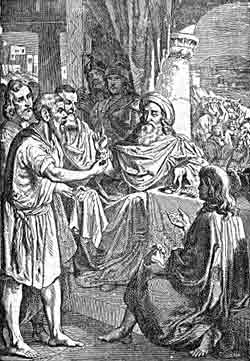
G0SPEL (Matt. XX. 1-6.) At that time, Jesus spoke to his disciples this parable: The kingdom of heaven is like to a householder, who went out early in the morning to hire laborers into his vineyard. And having agreed with the laborers for a penny a day, he sent them into his vineyard. And going out about the third hour, he saw others standing in the market place idle, and he said to them: Go you also into my vineyard, and I will give you what shall be just. And they went their way. And again he went out about the sixth and the ninth hour, and did in like manner. But about the eleventh hour, he went out, and found others standing; and he saith to them: Why stand you here all the day idle? They say to him: Because no man hath hired us. He saith to them: Go you also into my vineyard. And when evening was come, the Lord of the vineyard saith to his steward: Call the laborers, and pay them their hire, beginning from the last even to the first. When therefore they were come that came about the eleventh hour, they received every man a penny, But when the first also came, they thought that they should receive more; and they also received every man a penny. And receiving it, they murmured against the master of the house, saying: These last have worked but one hour and thou hart made them equal to us that have borne the burden of the day and the heats. But he answering said to one of them: Friend, I do thee no wrong; didst thou not agree with me for a penny? Take what is thine, and go thy way; I will also give to this last even as to thee. Or, is it not lawful for me to do what I will? Is thy eye evil, because I am good? So shall the last be first, and the first last. For many are called, but few are chosen. In this parable, what is to be understood by the householder, the vineyard, laborers, and the penny? The householder represents God, who in different ages of the world, in the days of Adam, Noah, Abraham, Moses, and finally, in the days of Christ and the apostles, has sought to call men as workmen into His vineyard, the true Church, that they might labor there industriously, and receive the penny of eternal glory. How and when does God call people? By inward inspiration, by preachers, confessors, spiritual books, and conversations, etc., in flourishing youth and in advanced age, which periods of life may be understood by the different hours of the day. What is meant by working in the vineyard? It means laboring, fighting, suffering for God and His honor, for our own and the salvation of others. As in a vineyard we spade, dig, root out weeds, cut off all that is useless and noxious, manure, plant, and bind up, so in the spiritual vineyard of our soul we must, by frequent meditation on death and hell, by examination of conscience dig up the evil inclinations by their roots, and by true repentance eradicate the weeds of vice, and by mortification, especially by prayer and fasting cut away concupiscence; by the recollection of our sins we must humble ourselves, and amend our life; in place of the bad habits we must plant the opposite virtues and bind our unsteady will to the trellis of the fear of God and of His judgment, that we may continue firm. How is a vice or bad habit to be rooted up? A great hatred of sin must be aroused; a fervent desire of destroying sin must be produced in our hearts; the grace of God must be implored without which nothing can be accomplished. It is useful also to read some spiritual book which speaks against the vice. The Sacraments of Penance and of Holy Communion should often be received, and some saint who in life had committed the same sin, and afterwards by the grace of God conquered it, should be honored, as Mary Magdalen and St. Augustine who each had the habit of impurity, but with the help of God resisted and destroyed it in themselves; there should be fasting, alms-deeds, or other good works, performed for the same object, and it is of great importance, even necessary, that the conscience should be carefully examined in this regard. Who are standing idle in the market place? In the market-place, that is the world, they are standing idle who, however much business they attend to, do not work for God and for their own salvation; for the only necessary employment is the service of God and the working out of our salvation. There are three ways of being idle: doing nothing whatever; doing evil; doing other things than the duties of our position in life and its office require, or if this work is done without a good intention, or not from the love of God. This threefold idleness deprives us of our salvation, as the servant loses his wages if he works not at all, or not according to the will of his master. We are all servants of God, and none of us can say with the laborers in the Vineyard that no man has employed us; for God, when He created us, hired us at great wages, and we must serve Him always as He cares for us at all times; and if, in the gospel, the householder reproaches the workmen, whom no man had hired, for their idleness, what will God one day say to those Christians whom He has placed to work in His Vineyard, the Church, if they have remained idle? Why do the last comers receive as much as those who worked all day ? Because God rewards not the time or length of the work, but the industry and diligence with which it has been performed. It may indeed happen, that many a one who has served God but for a short time, excels in merits another who has lived long but has not labored as diligently. (Wisd. IV. 8-13.) What is signified by the murmurs of the first workmen when the wages were paid? As the Jews were the first who were called by God, Christ intended to show that the Gentiles, who were called last, should one day receive the heavenly reward, and that the Jews have no reason to murmur because God acted not unjustly in fulfilling His promises "to them, and at the same time calling others to the eternal reward. In heaven envy, malevolence and murmuring will find no place. On the contrary, the saints who have long served God wonder at His goodness in converting sinners and those who have served Him but a short time, for these also there will be the same penny, that is, the vision, the enjoyment, and possession of God and His kingdom. Only in the heavenly glory there will be a difference because the divine lips have assured us that each one shall be rewarded according to his works. The murmurs of the workmen and the answer of the householder serve to teach us, that we should not murmur against the merciful proceedings of God towards our neighbor, nor envy him; for envy and jealousy are abominable, devilish vices, hated by God. By the envy of the devil, death came into the world. (Wisd. II. 24.) The envious therefore, imitate Lucifer, but they hurt only themselves, because they are consumed by their envy. "Envy," says St. Basil "is an institution of the serpent, an invention of the devils, an obstacle to piety, a road to hell, the depriver of the heavenly kingdom.” What is meant by: The first shall be last, and the last shall be first? This again is properly to be understood of the Jews; for they were the first called, but will be the last in order, as in time, because they responded not to Christ's invitation, received not His doctrine, and will enter the Church only at the end of the world; while, on the contrary, the Gentiles who where not called until after the Jews, will be the first in number as in merit, because the greater part responded and are still responding to the call. Christ, indeed, called all the Jews, but few of them answered, therefore few were chosen. Would that this might not also come true with regard to Christians whom God has also called, and whom He wishes to save. (I. Tim. II. 4.) Alas! very few live in accordance with their vocation of working in the vineyard of the Lord, and, consequently, do not receive the penny of eternal bliss. PRAYER O most benign God, who, out of pure grace, without any merit of ours, hast called us, Thy unworthy servants, to the true faith, into the vineyard of the holy Catholic Church, and dost require us to work in it for the sanctification of our souls, grant, we beseech Thee, that we may never be idle but be found always faithful workmen, and that that which in past years we have failed to do, we may make up for in future by greater zeal and persevering industry, and, the work being done, may receive the promised reward in heaven, through Jesus Christ, Thy Son our, Lord. Amen. |