|
Rev.
Fr. Leonard Goffine's
The Church's Year
QUINQUAGESIMA
SUNDAY
The Introit of this day's
Mass is the sigh of an afflicted soul confiding in God:
INTROIT
Be thou unto me a God, a protector, and a place of refuge, to save
me: for thou art my strength and my refuge: and for thy name's sake
thou wilt be my leader, and wilt nourish me. (Fs. XXX. 3. 4.) In
thee , O Lord, I have hoped, let me never be confounded: deliver
me in thy justice, and set me free. (Ps. XXX. 2.)
COLLECT
O Lord, we beseech Thee, graciously hear our prayers, and unloosing
the bonds of our sins, guard us from all adversity. Through our
Lord, etc.
EPISTLE
(I. Cor. XIII. 1-13.) Brethren, if I speak with the tongues of men
and of angels, and have not charity, I am become as sounding brass
or a tinkling cymbal. And if I should have prophecy, and know all
mysteries and all knowledge, and if I should have all faith, so
that I could remove mountains, and have not charity, I am nothing.
And if I should distribute all my goods to feed the poor, and if
I should deliver my body to be burned, and have not charity, it
profiteth me nothing. Charity is patient, is kind: charity envieth
not; dealeth not perversely; is not puffed up; is not ambitious;
seeketh not her own; is not provoked to anger; thinketh no evil;
rejoiceth not in iniquity, but rejoiceth in the truth; beareth all
things, believeth all things, hopeth all things, endureth all things.
Charity never falleth away: whether prophecies shall be made void,
or tongues shall cease, or knowledge shall be destroyed. For we
know in part, and we prophesy in part: but when that which is perfect
is come, that which is in part shall be done away. When I was a
child, I spoke as a child, I understood as a child, I thought as
a child: but when I became a man, I put away the things of a child.
We see now through a glass in a dark manner; but then face to face.
Now I know in part; but then I shall know even as I am known. And
now there remain faith, hope, charity, these three: but the greatest
of these is charity.
EXPLANATION
In this epistle St. Paul speaks of the necessity, the excellence
and the nature of true charity. He says that all natural and supernatural
gifts, all good works, even martyrdom, cannot save us if we have
not charity; because love alone can render our works pleasing to
God. Without charity, therefore, though ever so many prayers be
recited, fasts observed , and good deeds performed, nothing will
be acceptable to God, or merit eternal life. Strive then, O Christian
soul, to lead a pious life in love, and to remain always in the
state of grace.
Can
faith alone, as the so-called Reformers assert, render man just
and save him?
Faith alone, however strong, though it
could move mountains, without love, that
is, without good works performed for love
of God and our neighbor, can never justify
or save us. For, when St. Paul says, that
man is justified by faith without works,
(Rom. III. 28.; XI: 6.; Eph. II. 8. 9.)
he means to refer to those works which
were performed by command of the law of
Moses, and which, as they were external
and without true charity, were of no avail;
he did not refer to those works which
are performed in a state of grace with
a lively, love-inspired faith. Therefore
the same Apostle writes to the Galatians:
(Gal. V. 6.) Faith only availeth which
worketh by charity; to Titus: (Tit. III.
8.) It is a faithful saying: and these
things I will have thee affirm constantly:
that they who believe in God, may be careful
to excel in good works. These things are
good and profitable unto men; and he exhorts
the Colossians (Colos. I. 10.) to be fruitful
in every good work. St. James confirms
the same by saying: (James II. 17-24.)
So faith if it have not works, is dead
in itself; by works man is justified and
not by faith only. That this is the true
doctrine of Christ is evident from His
own words, when He says: "Every tree
that bringeth not forth good fruit, shall
be cut down and shall be cast into the
fire." (Matt. VII. 19.) At the day
of judgment Christ will demand good works
from all men, (Matt. XXV. 35.) and will
not judge them only according to their
faith, but by their good works, which
true faith must always produce. (Apoc.
XX. 12.) Would Christ and His apostles
demand good works, if faith alone be sufficient?
"The devils also believe and tremble,"
(James II. 19.) they believe, but they
are not saved, and their faith but increases
their torments. Therefore, the assertion
that faith without good works is sufficient
for justification and salvation, is plainly
against the doctrine of Christ and His
Church, and must of necessity lead man
to vice and misery, as shown by the history
of the unhappy separation of the sixteenth
century
Are
good works available which are performed in the state of mortal
sin ?
Good works performed while in a state
of mortal sin avail nothing in regard
to eternal life, writes St. Lawrence Justinian,
but aid in moderating the punishment imposed
for disobedience and the transgression
of God's commandments. They bring temporal
goods, such as honor, long life, health,
earthly happiness, etc.; they prevent
us from falling deeper into sin, and prepare
the heart for the reception of grace;
so the pious person writes: "Do as
much good as you can, even though in the
state of mortal sin, that God may give
light to your heart."
ASPIRATION
O God of love, pour the spirit of true charity into my heart that,
according to the spirit of St. Paul, I may endeavor to be always
in a state of grace; that all my works may be pleasing to Thee,
and meritorious for me.
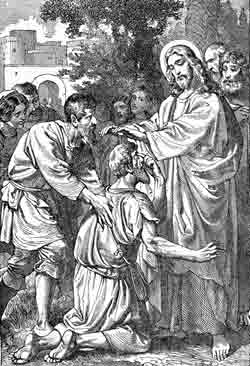
GOSPEL
(Luke XVIII. 31-43.) At that time, Jesus took unto him the twelve,
and said to them Behold, we go up to Jerusalem, and all things shall
be accomplished which were written by the prophets concerning the
Son of Man. For he shall be delivered to the Gentiles, and shall
be mocked, and scourged, and spit upon; and after they have scourged
him, they will put him to death; and the third day he shall rise
again. And they understood none of these things, and this word was
hid from them, and they understood not the things that were said.
Now it came to pass, when he drew nigh to Jericho, that a certain
blind man sat by the way-side, begging. And when he heard the multitude
passing by, he asked what this meant. And they told him that Jesus
of Nazareth was passing by. And he cried out, saying: Jesus, Son
of David, have mercy on me. And they that went before rebuked him,
that he should hold his peace. But he cried out much more: Son of
David, have mercy on me. And Jesus standing, commanded him to be
brought unto him. And when he was come near, he asked him, saying:
What wilt thou that I do to thee? But he said: Lord, that I may
see. And Jesus said to him: Receive thy sight; thy faith hath made
thee whole. And immediately he saw, and followed him, glorifying
God: and all the people, when they saw it, gave praise to God.
Why
did Christ so often foretell His passion to His disciples?
Because He wanted to show
how great was His desire to suffer for us, for we speak often of
that which we crave; and because He wished His disciples when they
should see Him treated as a criminal and martyred, not to think
evil of Him, or imagine themselves deceived, but remember that He
had foretold all minutely that all happened of His own will.
Did
not the disciples understand anything of what He predicted in regard
to His future sufferings?
They may, certainly, have
well understood He was to suffer, for which reason Peter tried to
dissuade Him from it; (Matt. XVI. 22.) but they did not comprehend
why or for what He would suffer, or how He would rise again. All
this the Holy Ghost gave them to understand, after it had come to
pass. (John XIV. 26.) The light of the Holy Ghost is of so much
value, that without it even the clearest doctrines of faith are
not understood.
Why
does Christ so often call Himself the Son of Man?
He wished to show, in the
Jewish way of speaking, He was also man, a descendant of Adam, and
that we should be humble, and not seek or desire high titles.
Why
did the blind man call Christ the Son of David?
Because, like all the Jews,
he believed that the Messiah, according to humanity, would be of
the house of David, as was promised. (Ps. CXXXI. 11.)
Why
did Christ ask the blind man: What wilt thou that I do to thee?
This He asked, not because
He was unaware of the blind man's wish, but to enable him the better
to prove his faith and hope that through Christ he would receive
his sight; and to teach us how willing He is to help us, and how
it pleases Him if we confidingly place our wants before Him. We
should learn from this blind man, who would not be restrained by
the passing crowd in his ardent and reiterated request, not to pay
attention, in the work we have commenced, to human respect, or human
judgment, but to persevere, and not allow ourselves to be led astray
by the world's mockery or contempt. We should also learn to be grateful
to God, and faithfully cling to Him, if He has once opened the eyes
of our mind, and healed our spiritual blindness, which is far more
deplorable than physical blindness, for nothing can be more miserable
than not to see and understand God, not to know what is necessary
for our salvation, and what is pernicious.
Why
is this gospel read on this Sunday?
The Church wishes to remind
us of the painful passion and death of Jesus, and to move us by
the contemplation of those mysteries to avoid and despise the wicked,
heathenish amusements of carnival, sinful pleasures which she has
always condemned, because they come from dark paganism, and, to
avert the people from them, commands that during the three days
of carnival the Blessed Sacrament shall be exposed for public adoration,
sermons given, and the faithful exhorted to have recourse at this
time to the Sacraments of Penance and the Blessed Sacrament of the
Altar, with the reception of which Pope Clement XIII. (Breve, 23.
June 1765) connected a plenary indulgence. A true Catholic will
conform to the desire of his holy Church, considering the words
which St. Augustine spoke,
at this time, to the faithful, "The heathens (as also the wordly
people of our days) shout songs of love and merriment, but you should
delight in the preaching of the word of God; they rush to the dramatic
plays, but you should hasten to Church; they are intoxicated, but
you should fast and be sober."
PRAYER
O most benign Jesus! who didst so desire to suffer for us,
grant, that we may willingly suffer for love of Thee; that we may
hate and flee from the detestable pleasures of the world and the
flesh, and practice penance and mortification, that by so doing
we may merit to be released from our spiritual blindness to love
Thee more and more ardently, and finally possess Thee forever.
INSTRUCTION
ON LENT
Who
instituted Lent?
According to the fathers
of the Church, Justin and Irenaeus, the fast before Easter was instituted
and sanctified by Christ Himself; according to the saints Leo and
Jerome, the holy apostles ordained it given by Jesus.
Why
has the Church instituted this fast forty days before Easter?
To imitate Christ who fasted
forty days; to participate in His merits and sufferings; to subject
our flesh by voluntary mortification to the spirit, and to mortify
our evil desires as did St. Paul; (Col. I. 24.) to enable us to
lead a pure life, and thus prepare for the holy festival of Easter,
and the reception of the divine Lamb, Jesus: and, finally, to render
God satisfaction for our sins, and do penance, as Pope Gregory says,
for the sins of one whole year by one short fast, lasting only the
tenth part of a year.
Was
the fast of Lent observed in early times as in the present?
Yes, but more strictly;
for the people of the early ages not only abstained from meat, but
also from all that which is connected with it, such as eggs, butter,
cheese, etc., even from wine and fish, although this was not the
general command of the Church; they fasted all day, and only ate
in the evening after vespers, in remembrance of which, vespers are
now said before dinner-time, because the Church, as a kind mother,
now permits the supper to be changed into a dinner, and also allows
something to be taken in the evening, that the body may not be too
much weakened, and become unfit for labor.
How much does this ancient
custom put to shame the Christians of to-day who think the fast
in our times too severe! "But," asks St. Ambrose, "what
sort of Christians are they? Christ, who never sinned fasted for
our sins, and we will not fast for our own great and numerous offences?"
How
should the holy season of Lent be spent?
As according to the teaching
of St. Leo, the main thing in fasting is not that the body be deprived
of food, but that the mind at the same time be withdrawn from wickedness,
we should endeavor during Lent, not only to be temperate in eating
and drinking, but especially to lead a modest life, sanctifying
the days by persevering prayer and devoutly attending church.
PRAYER
AT THE BEGINNING OF LENT
Almighty God! I unite myself
at the beginning of this holy season of penance with the Church
militant, endeavoring to make these days of real sorrow for my sins
and crucifixion of the sensual man. O Lord Jesus! in union with
Thy fasting and passion, I offer Thee my fasting in obedience to
the Church, for Thy honor, and in thanksgiving for the many favors
I have received, in satisfaction for my sins and the sins of others,
and that I may receive the grace to avoid such and such a sin, N.
N. and to practice such and such a virtue, N. N.
|




